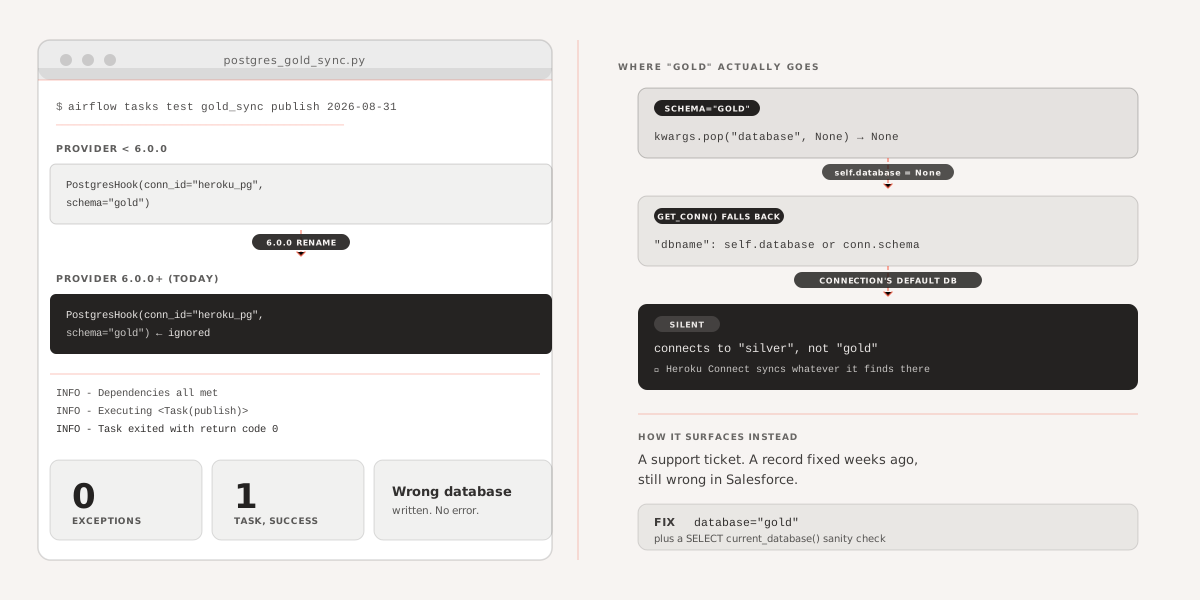
Airflow’s Postgres connection form has had a field called “Schema” since the project’s earliest versions, and that field has never held a schema. It holds a database name, the thing you’d pass to psql -d. Nobody building DAGs day to day thought much about the mismatch until apache-airflow-providers-postgres 6.0.0 shipped in December 2024 and renamed the hook’s own schema argument to database, saying so directly in the changelog: the old name “contained the database name” and was wrong. The deprecated alias didn’t linger for a release or two. It was gone in the same version.
If you skimmed that line, one entry among a dozen breaking changes in a provider major bump, and your DAGs kept running green afterward, that isn’t because nothing broke. It’s because this particular break doesn’t raise.
Why this is the one people miss
Most renamed arguments fail loud. Pass a keyword a function doesn’t recognize and Python throws TypeError: unexpected keyword argument. That’s not what happens here, because PostgresHook.__init__ doesn’t validate its kwargs against an allowlist. It forwards them:
def __init__(
    self, *args, options=None, enable_log_db_messages=False, **kwargs
) -> None:
    super().__init__(*args, **kwargs)
    self.database: str | None = kwargs.pop("database", None)
    self.options = options
    self.enable_log_db_messages = enable_log_db_messages
Pass schema="gold" today and kwargs.pop("database", None) finds nothing, so self.database stays None. But schema was already forwarded to the parent class two lines earlier, via super().__init__(*args, **kwargs). The base DbApiHook, from the common-sql provider, still declares its own schema parameter. It always has, so it accepts the value without complaint and quietly stores it somewhere nobody downstream reads for the connection you actually wanted.
Then get_conn() decides which database to connect to with one line:
"dbname": self.database or conn.schema,self.database is None, so it falls through to conn.schema, the Schema field on the Airflow Connection object itself, the one that’s meant “database” this whole time. The task connects. The query runs. The DAG goes green. It’s just talking to whatever database that Connection was configured to point at by default, not the one the task actually asked for.
Where this bites a Salesforce pipeline specifically
This is the exact shape of the medallion pattern we’ve written about before: one Heroku Postgres instance, one Airflow deployment on the same platform, bronze/silver/gold tables marking how far a record has gotten through validation, and Heroku Connect pointed only at gold. The pattern’s whole value is that Heroku Connect never sees a half-processed row.
The convenient way to run three layers off one Postgres server is one Airflow connection, heroku_pg, and a per-task override telling each task which layer it’s working in:
PostgresHook(postgres_conn_id="heroku_pg", schema="gold")On Heroku specifically, that connection’s Schema field usually isn’t something anyone typed by hand. heroku config:get DATABASE_URL returns a path component after the host, postgres://user:pass@host:5432/dbname, and whoever wired the Airflow connection up as AIRFLOW_CONN_HEROKU_PG or through the UI carried that dbname straight across. It’s whatever database Heroku’s Postgres add-on provisioned for the dyno, not a name anyone chose to mean “silver” or “gold.” The per-task schema= override was doing real work precisely because the connection’s own default meant nothing semantically.
That line worked for every provider release up to 5.x. On 6.0.0 and everything after, it’s a no-op. The task falls back to whatever database heroku_pg’s own Schema field names, commonly whichever layer someone configured first. Often silver, because that’s usually the connection wired up earliest in the DAG’s history. A task that thinks it’s reading gold reads silver instead. A task meant to publish into gold writes into silver. Heroku Connect keeps polling gold on its own schedule, sees no new rows, and syncs nothing. Or worse, sees rows that were supposed to still be quarantined.
Nothing in that chain throws an exception. The DAG’s task history shows a clean run. The first symptom is usually a support ticket: a record a rep swears they fixed last week is still wrong in Salesforce, or a duplicate showed up that the silver-layer validation was supposed to have caught months ago. By the time someone traces it back to a hook argument, they’ve usually spent longer ruling out Heroku Connect’s own mapping, the External ID field, and the validation rules than it took to introduce the bug.
Why teams hit a change from December 2024 in 2026
The rename itself isn’t new. What’s new is that Airflow 3 migrations are the reason teams are opening this changelog at all. A shop that’s been quietly running Airflow 2.8 or 2.9 for two years doesn’t read every provider release note along the way. There’s no reason to, when nothing is forcing an upgrade. The Airflow 3 migration is what forces it, and when it does, it usually means jumping several provider majors in one sitting rather than one at a time. The schema rename rides along in the same diff as a dozen other changes that look more urgent: PostgresOperator itself was removed in that same 6.0.0 release, in favor of SQLExecuteQueryOperator. That one does fail loud, an ImportError at DAG parse time, which is why it gets fixed first while the quieter rename gets missed entirely.
By the time a team is running provider 7.x, the current line, which switched the default driver to psycopg3 and adjusted its async URL scheme for Airflow 3.4, the schema kwarg has been gone for six versions and nobody remembers it was ever load-bearing. Whoever wrote schema="gold" in the first place has probably moved teams.
What to check before the upgrade, not after
Grep the DAG repo for schema= on any PostgresHook( or SQLExecuteQueryOperator( call before touching the provider version, not after:
grep -rn 'schema=' dags/ | grep -iE 'postgreshook|sqlexecutequeryoperator|hook_params'Every hit needs to become database=. If several tasks share one connection and differentiate only by that argument, that’s worth a second look regardless of the provider version. A connection whose default database silently decides behavior when an override is missing is a trap whether the override is spelled schema or database. Point each layer at its own named connection, or make the database name an explicit DAG parameter instead of leaning on the Connection’s default.
Add a cheap sanity check while you’re in there. A single SELECT current_database(); at the start of a task, logged and compared against what the task expects, turns a silent wrong-database write into a failed task the next time someone mistypes an argument. That costs one line and catches the next version of this same mistake, not just this one. It is also the fastest way to confirm, before the upgrade ships, that every task is still landing where its DAG author intended.
We build and maintain Airflow pipelines that feed Salesforce through Heroku Connect, including the medallion layering this post describes. If you’re moving DAGs toward Airflow 3 and want a second pair of eyes on what else rides along in that jump, see how we approach data pipelines, or look at the pipeline we run for a manufacturing client’s CRM and ERP sync. Otherwise, get in touch.